15/09/2026
When talking about reuse, we naturally think about preserving the operating or the functional value of a product and its components even after decommission. In EU circular economy policies, this principle is embedded in the waste hierarchy: prevention → preparing for reuse → recycling → recovery → disposal. That means reuse is preferred before recycling, especially when backed by life-cycle impacts.
SOLMATE aims to prioritise reuse before recycling, and we have already seen how CEA, Soren and Certisolis are preparing second-life photovoltaic (PV) panels for the project’s demonstrators. At the same time, Watt4Ever (W4E) have been developing safety testing protocols and a quality control handbook for second-life batteries. Both PV panels and batteries will be reused in decentralised energy solutions demonstrated across three use cases.
SOLMATE is not simply demonstrating the feasibility of these decentralised energy systems; its partners are developing at the same time solutions that address a practical problem in the reused sector: there is no widely adopted methodology for assessing PV panels and battery modules that combine safety, performance and degradation analysis in a single framework.
In the case of electric vehicles (EVs), batteries are usually removed from service when they no longer meet the performance requirements of the car. Many often still have enough capacity to power less demanding applications, such as stationary energy storage. Therefore, a battery that is no longer suitable for driving can still be used to store electricity produced with solar panels, thus supporting a building’s energy system or even providing backup power. By simply reintegrating these decommissioned batteries in an operating system, we extend the use of materials and components that have already been produced and delay, at the same time, the need for recycling.
Battery degradation and State of health
The handbook put together by W4E explains that battery ageing is driven by a range of physical and chemical processes, among which: the growth of solid electrolyte interphase, loss of active material, transition metals dissolution and lithium plating. In time, these processes affect battery performance and their safety.
The analysis covers different lithium-ion cell formats (cylindrical, prismatic, pouch cells). Although ageing mechanisms are similar, the rate and pattern of degradation can vary depending on the battery design, its chemistry and operating conditions.
The handbook prepared by specialists at W4E lists a set of commonly used test types to establish the State of Health (SoH) of a battery:
- capacity retention testing: it assesses how much energy the battery can currently store, but cannot explain how the degradation process produced across time or how the battery is likely to age in the future.
- internal resistance measurements: it increases as the battery ages and can provide an indication of performance loss. Similar to the capacity retention, on its own, it cannot disclose the degradation causes.
- open circuit voltage (OCV): is measured after a rest period and can provide information about the charge state and the changes in battery behaviour over time. On its own, OCV provides indirect information, therefore it is usually coupled with other batches of tests.
- hybrid pulse power characterisation (HPPC): evaluates a battery’s response under different power loads and pulse conditions, and can measure its ability to deliver and receive power.
- cell balancing and voltage consistency verifications: analyse the voltage behaviour of each cell in the module to identify similarities or differences in cell deterioration.
- model-based diagnosis: W4E handbook used different battery models together with measured test data to compare behaviours against expected performance and identify degradation patters. This method indicates how a battery’s internal condition has changed and estimates the types of degradation processes that may be occurring. The disadvantage of the model-based diagnosis lies in the necessity to pair it with specialised modelling and interpretation.
Qualifying decommissioned batteries for reuse, W4E’s handbook argues, is a complex task that cannot rely on remaining capacity or internal resistance measurements. These indicators can create a snapshot of a battery’s condition, quantifying how much a battery has degraded after its first use, but cannot explain why.
W4E allocated effort into identifying the processes that drive battery ageing and they flagged two specific degradation mechanisms that provide a closer indication of future battery behaviour than capacity measurements alone:
- loss of active material (LAM): a process where electrode materials gradually lose their ability to store energy;
- loss of lithium inventory (LLI): a process where lithium becomes unavailable for normal battery operations, reducing its capacity.
Battery safety needs to be assessed separately from performance
A battery can still perform well even when it presents safety concerns. The authors of the handbook propose a selection protocol for lithium-ion batteries (LIBs) for second-life applications based on a combination of three evaluation categories:
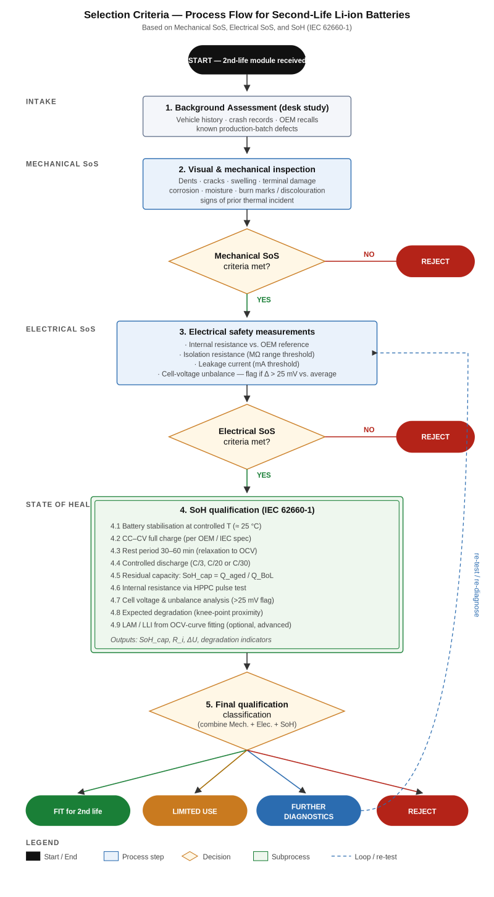
- Mechanical State of Safety (Mechanical SoS): evaluates whether the battery module or pack has suffered physical damage that could compromise safe operation. It relies mainly on physical inspection meant to identify deformation signs, corrosion, moisture, dirt or other debris indications, traces of overheating or evidence of previous thermal incidents etc. W4E specialists recommend an additional background assessment (“desk study”) to evaluate the historical use of the LIB, which should include: identification of the original vehicle application, verification whether the vehicle was involved in a crash or severe accident , review of manufacturer recalls, identification of known manufacturing defects related to the battery type or production batch.
Many modules can be excluded already after a careful preliminary visual inspection. - Electrical State of Safety (Electrical SoS): evaluates whether the battery remains electrically stable and safe for continued operation and should include the following measurements: internal and isolation resistance, current leakage that ideally should remain within the OEM’s specifications, and cell voltage measurements.
Batteries showing excessive cell imbalance, abnormal resistance behaviour or insufficient isolation resistance should be excluded from second-life deployment. - State of Health (SoH): evaluates the remaining functional capability of the battery and its expected degradation behaviour in the future. The SoH assessment should include: residual capacity compared to beginning-of-life capacity, internal resistance evolution, expected degradation trend and proximity to accelerated ageing (“knee point”), historical operational information (when available) and the number of equivalent full cycles completed during first-life operations.
The handbook drafted by W4E stands out through a few innovative approaches that prove to be equally cost-effective. It places emphasis on non-destructive testing methodologies. Dismantling batteries is costly, time-consuming and can expose operators to additional safety risks. For second-life applications and taking into account upcoming batches of EV batteries that will soon reach the end of their life, a qualification protocol must be capable of handling large numbers of modules without extensive laboratory procedures.
W4E’s testing methodology proposes an upgrade to the existing standards (IEC-EN 62619 and UL1974), combining traditional battery testing with degradation analysis. Understanding second-life batteries’ condition, safety and degradation history provides a good basis for deciding how and whether they should be used again.
Selection criteria – process flow for second-life LIBs | ©Watt4Ever