14/07/2025
At the end of 2024, researchers at VITO and Inflights were already testing the first components of the drone inspection workflow under real-world conditions. This validation campaign confirmed that the communication channels between the interfaces developed by the partners are functioning reliably and in compliance with the region-specific operating restrictions for drones.
Early in 2025, the project moved towards more experimental phases, aiming to define the optimal recipe for drone acquisition. Different flight and payload configurations were tested including parameters such as image overlap, ground resolution, camera shutter speed, etc. Preliminary findings from the first inspection campaigns revealed that high-altitude flights – leading to low resolution and image overexposure in bright sunlight conditions prevent defect detection. Good news is that the thermal imaging of these recent drone inspection flights have already revealed anomalies in several panels, providing promising results at these early stages.
-
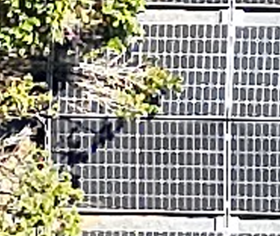
- 50m, 1/800sec, 12MP, © Engie Laborelec
-
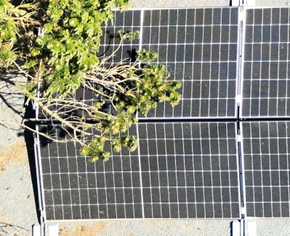
- 12m, 1/2000sec, 48MP, © Engie Laborelec
Comparison of two drone images of the same scene with different altitudes, shutter speeds and pixel sizes [© VITO and Inflights]
A standard drone inspection campaign scans a PV site of approx. 240 panels in just 20-25 minutes, with a post-processing time up to one hour. Perhaps an even more interesting outcome is the potential to generate a 3D model of the PV plant using only the imagery collected with the drone inspection. This may become helpful for the KU Leuven team developing the robotic system for PV panels dismantling.
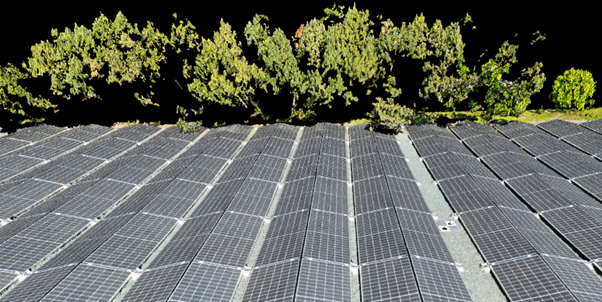
3D point cloud of the PV site. The slope of each individual PV panel can be extracted, © Engie Laborelec
Always on the lookout to improve the workflow, the duo VITO-Inflights plans for a more comprehensive drone acquisition campaign during the summer of 2025.
Customising tools for the autonomous robotic solar panel dismantling
After the drone inspection, SOLMATE will have to demonstrate a completely autonomous robot tailored for solar farms, which will disassemble and sort dysfunctional modules. The research team at KU Leuven and VITO is currently developing the detailed design of the disassembly unit and the panel receptor platform, which will be installed on one of the mobile cleaning robots provided by SolarCleano.
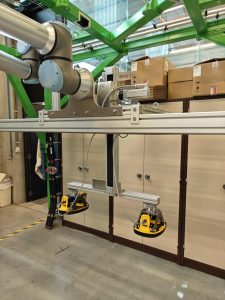
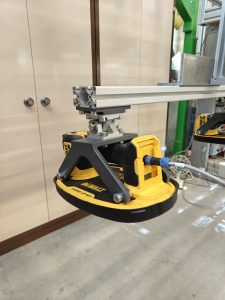
Yet, the engineering challenge extends beyond simply tuning the cleaning robot design for dismantling tasks. PV panels are both heavy and fragile. Standard off-the-shelf tools are thus inadequate for disassembly operations. To address this, researchers are designing customised tools that will enable the robot to safely manage both the load and the fragility of the PV modules.
-
- © KU Leuven