15/09/2026
A brief incursion into the R&I journey of SOLMATE reminds us that the project aims to couple reused applications (electric-car batteries and solar panels) in decentralised energy storage solutions. The role of the Energy Management System (EMS) becomes particularly interesting in these systems: it monitors, controls and optimises the operations of these second-life applications, ensuring they keep working safely and reliably. But beyond the safety and operational purposes, the EMS can support a ten-year performance warranty on the repurposed assets.
A flexible Energy Management System
Within SOLMATE project, ReVolta has developed an EMS that coordinates the use of energy assets at a site, covering generation, storage, and flexible loads, to meet operational and economic objectives.
For second-life batteries, this management on energy becomes even more important. Batteries entering their second life have different usage histories and may use different cell chemistries. As a reference, the chemistries across the SOLMATE supply chain include Lithium Titanate Oxide (LTO), Nickel Manganese Cobalt (NMC) and Lithium Iron Phosphate (LFP) batteries. Each of these behaves differently in terms of voltage, temperature and ageing. The EMS therefore needs to account for the characteristics and condition of the battery accordingly.
The configuration of the EMS uses two connected layers:
- the StoreNet cloud platform which collects data, forecasts local electricity demand and photovoltaic generation, configurates schedules and allows remote management.
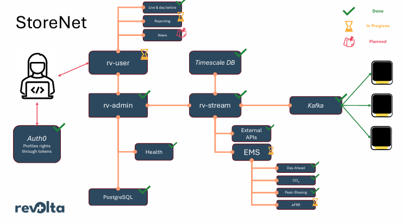
Architecture peration StoreNet cloud platform | ©ReVolta
The platform combines information specific to the demonstration site with external data such as electricity prices and grid carbon intensity. Based on this information, coupled with demand and solar production predictions, ReVolta’s OptiSchedule algorithm optimises the battery charging-discharging schedules. This is aligned with technical limits such as available capacity and maximum power. The scheduling algorithm proposes different operating modes. When users select ‘cost mode’, the battery discharges when energy prices are high and charges when they are low; in ‘CO₂ mode’, the platform follows the carbon intensity signal; in ‘autonomy mode’, the focus is on absorbing PV surplus and covering local load without grid imports.
- EdgeNet which is an on-site controller that communicates with the inverter and battery system, collects real-time measurements and applies the operating schedule generated by the cloud.
EdgeNet can continue working independently even when the cloud connection is interrupted, storing key information locally so that operation can resume after the restart. For operators, this means that forecasting and optimisation can take place centrally, while essential control remains available at the site.
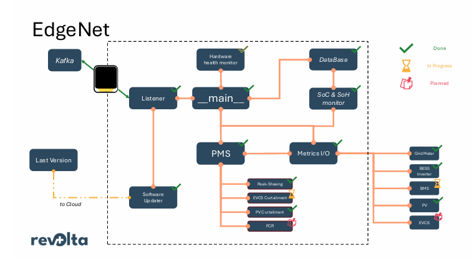
Scheme operation EdgeNet | ©ReVolta
Battery monitoring
Energy optimisation is only part of the challenge addressed by the EMS. Operators also need reliable information about the condition of a repurposed battery. A battery’s original Battery Management System (PMS) may estimate State of Charge (SoC) using parameters developed for its initial application. As the battery ages, its capacity and internal resistance change, so these values may no longer fully reflect its current condition.
A system simply cannot rely on obsolete information stored in the original BMS. Reused batteries also come with different operating histories, in various conditions and chemistries. Given the variety of applications and unreliable historic information, ReVolta developed an EMS that can estimate the SoC of reused batteries independently, disregarding information from the BMS. This is integrated within EdgeNet and it regularly updates model parameters using operational data as battery behaviour changes.
The system also tracks State of Health (SoH) over time. The cloud builds a degradation history for each battery pack and compares its development with the expected trajectory for that chemistry and usage profile. If the system detects unexpected capacity or resistance changes, it generates a maintenance alert. This information can help operators identify potential problems earlier, plan maintenance and document how the battery has been used. It also provides monitoring data to support the ten-year performance warranty foreseen for the repurposed assets.
Different applications of EMS across SOLMATE Demonstrators
The EMS is deployed across three demonstrators within SOLMATE, each with a different application context, battery chemistry and set of operational objectives. The core architecture is shared across all three, but the hardware configuration, the communication path to the battery, the steering mode priorities and the ECM parameterisation differ.
Plug-in PV
The Plug-in PV demonstrator is led by SunCrafter and targets small residential systems combining PV installation with a compact second-life battery. Its main objective is to store excess PV electricity during the day and use it later when household demand is higher than PV production, avoiding relying too much on the grid services.
For this application, the project analysis found limited added value in using the full ReVolta EMS. Many of its advanced optimisation functions are not required at this scale, while additional hardware and cloud maintenance would increase costs. A simpler controller can therefore meet the main operational need. These finding highlights that adding more technology is not automatically the best solution.
Low-income energy solutions
The rural electrification demonstrator is led by Watt4Ever and was initially planned to be installed at a school campus in one of Brussels’s neighbourhoods. Its original site could not be connected to the grid, therefore a new location – this time in the rural area – is currently under investigation.
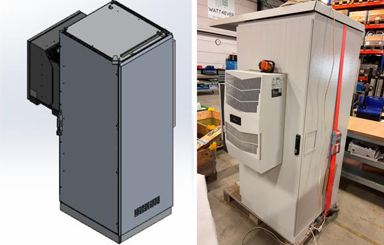
BESS design (left) and manufacturing (right) designed and developed by Watt4Ever
The priorities of this decentralised solution is energy autonomy, self-sufficiency and supply reliability rather than market participation. In line with these objectives, Watt4Ever designed the battery energy storage system (BESS) with a modular architecture so that individual battery modules and other components can be replaced without replacing the entire system. As designed, the installation should feature around 50 kWp of PV panels and 90 kWh of battery storage.
Repairability, as one of the key objectives, also shaped the design. Standardised electrical interfaces and accessible layouts aim to make inspection, troubleshooting and component replacement easier in environments where spare parts or specialised expertise may not always be readily available.
The EMS complements this physical design by monitoring battery operation and health, helping operators anticipate maintenance requirements rather than reacting only after a failure.
Agri-PV
The Agri-PV demonstrator is led by KU Leuven and located at the TRANSfarm research facility. The Agri-PV demonstrator combines second-life PV panels with a second-life battery pack recovered from retired hybrid buses. The battery uses LTO cells, whose voltage characteristics differ from NMC and LFP batteries. The monitoring model is therefore parameterised specifically for LTO chemistry.
Different from the other two demonstrators, in the case of Agri-PVs, the EMS can support on-site use of locally generated electricity and, depending on grid conditions, participation in energy markets. The demonstrator shows why battery chemistry needs to be considered when designing monitoring and control for second-life systems.
Some of the obstacles to using second-life applications may refer to uncertainty about their condition and economic value and/or whether they can work safely and reliably for years. SOLMATE is addressing these concerns from both side:
- developing protocols to test and qualify used PV panels [read more: Second-life energy systems: Supply, testing and qualification of PV panels – Solmate]
- using an EMS to monitor second-life batteries