04/09/2026
Previous articles have been explaining how SOLMATE qualifies decommissioned photovoltaic (PV) panels and electric vehicles (EV) batteries, for reuse in decentralised energy solutions. However, these articles mainly described relatively ideal operating conditions, where technical documentation, operational history and performance data are available. The qualification protocols for PVs and batteries prepared by SOLMATE partners have identified comprehensive lists of specific tests to assess safety, performance and state oh health. Many of these tests require dedicated equipment and expertise.
In reality, a waste management company receives products with limited documentation and missing diagnostic data. To comply with a comprehensive qualification approach, an operator would need to be equipped with specialised laboratory equipment, resources that are often incomplete or missing. The necessity to develop a qualification protocol based on relatively accessible methods became obvious as our SOLMATE project advanced.
Belgian company Out of Use (OOU), specialised in the reuse and recycling of materials, has been evaluating the potential for reusing Waste Electrical and Electronic Equipment (WEEE) components recovered from dismantled PV farms and EV batteries. The resulting framework provides dismantlers and recyclers with low-cost inspection and qualification procedures to determine whether components should be reused, refurbished, replaced or recycled.

Given practicality and speed were important requirements to align with the realities of waste management operators, one of the first findings of the OOU report is to preserve the entire functional product where possible, rather than destroying operating value through dismantling. In the case of PV panels, that normally means the entire module; for EV batteries, primarily the battery module or pack; for inverters, potentially the complete device.
PV panels: reuse the entire module
A PV panel’s configuration includes two types of components: the external elements, which are rather accessible (e.g. the frame, junction box, cables/connectors) and the laminated elements, which are very difficult to separate without damages (e.g. glass, solar cells, backsheets).
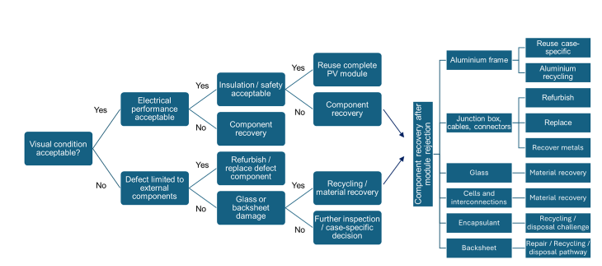
OOU assessed 90 modules in three batches using a protocol that combined visual inspection, electrical screening, safety verifications and component-level assessment.
Decision tree for PV modules and component-level reuse, refurbishment and recycling pathways | © Out of Use
Their conclusion confirms that the complete PV module is usually the most valuable second-life unit. Embedded PV components are integrated into a laminated structure and are therefore difficult to separate without damage. Their value is mainly retained when the complete module can be reused. If complete-module reuse is not feasible, recycling and material recovery become the most appropiate route.
External components, although easier to replace and refurbish, often face practical limitations due to their exposure to weather conditions.
- Junction boxes often show oxidation, damaged housings or degraded seals, defective bypass diodes. When aiming to dismantle junction boxes at around 1.5 minutes each, OOU operators concluded that prioritising speed would compromise the reusability of these components: out of 25 dismantled junction boxes, only 9 retained an intact housing and cover.
- Damaged cables can also limit reuse. Even when the PV module itself remains electrically functional, damaged or unsafe cables may prevent reliable testing and safe second-life operation.
- Connectors are generally low-cost components. Therefore, when their condition, compatibility, or safety is uncertain, replacement is often more appropriate than reuse.
EV batteries: high potential for reusability, but difficult to qualify
An EV battery reaches the end of its initial operation when its state of health (SoH) falls below 80%. While it may no longer be suitable to power a vehicle, it can serve less demanding applications, such as stationary storage solution. The battery assessment conducted by OOU confirmed a challenge already reported by W4E in SOLMATE: most batteries arrive in recycling facilities with missing information.
OOU used around 1170 battery modules, 99 EV packs and 16 stationary batteries to evaluate components. Only about 62% of modules could be linked to corresponding packs, in 90% of the cases the nominal voltage was missing and there was little to no access to SoH and battery management system (BMS) data. Based on their disassembly observations and aligned with the limitations imposed by incomplete data, OOU developed a low-cost screening protocol for EV battery components. The protocol follows a progressive assessment approach, starting with safety intake and registration, followed by visual inspection, traceability assessment, basic electrical screening, component-level classification and final pathway selection.
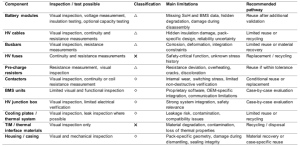
EV battery component-level reuse | © Out of Use
Batteries are often sent to recycling without a technical justification
A surprising finding of the assesment is that, for more than 97% of the samples evaluated by OOU, recycling was not driven by technical failure. Instead, the main barriers to reuse were OEM restrictions and contractual conditions. This implies that many decommissioned battery modules might still have remaining value that is wasted once these applications are sent directly to recycling. The implications are broader than battery testing itself, requiring a proportional response from OEMs, policy, business models.
As presented in the white paper of the Cluster Hub ‘Materials for Batteries’ – Considerations for R&I priorities in Europe’s battery raw materials chains – battery design itself works against second-life use. Batteries are still designed mainly for performance, cost and weight reduction, often with compact architectures, welded structures and adhesives that are difficult to disassemble. This design complexity makes end-of-life treatment not only more difficult, but also more expensive and sometimes even damaging.
We cannot enable reuse if products are designed in ways that make non-destructive recovery uneconomic or, in some cases, impossible.
Inverters and EV charging stations
Both inverters and chargers can be repurposed/refurbished, the OOU report finds. However, this depends strongly on the type of device, its internal configuration, and the availability of compatible components, software, and testing procedures. Due to their active electronic systems, they require additional functional and safety testing.
Internal components of inverters, such as wiring, terminal blocks, fans or housings, can be refurbished or reused when inspections confirm they remain in safe working conditions.
More complex electronic elements, such as printed circuit boards (PCBs) and power electronics, often depend on proprietary firmware, manufacturer-specific configurations and software, making refurbishment and reusability difficult. These components contain important metals, some critical or strategic. Recycling is the reasonable route where the value of these metals can be recovered and revalorised.
A decision framework for real dismantling environments
The protocol proposed by OOU gives SOLMATE a framework potentially applicable to other waste management operators: a practical decision framework anchored in the reality of dismantling facilities, where products arrive with missing documentation, and where testing budgets and dismantling resources are scarce. The framework uses low-cost screening to determine which components can be considered for reuse, which are requiring further testing or refurbishment, and establish those that should proceed to recycling.