12/03/2026
Europe is expected to face an increase in decommissioned solar PV panels in the upcoming years, and the same trend is expected for electric vehicles’ (EV) batteries. Rather than sending these components straight to recycling, SOLMATE is testing alternatives where they can be reused in new decentralised energy systems. In an economy dominated mainly by linear consumption models, the project aims to identify the settings in which reused PV panels and EV batteries can work technically and make financial sense.
After identifying the techno-economic prerequisites for the reuse of second-life applications, Engie Laborelec modelled SOLMATE’s three demonstrators and finalised the sensitivity analysis for each, extracting recommendations for dimensioning and operations for real deployments. Having little to no previous pricing data for second-life PV and EV battery modules clearly challenged the delivery of the study, but the techno-economic assessment nevertheless revealed initial conclusions for the three SOLMATE demonstrators to be built with reused PV panels and second-life EV batteries.
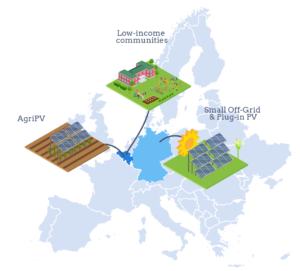
- the Agri-PV installation, where solar panels are mounted in vertical rows on farmland
- the small plug-in PV (PiPV) system for households
- the medium-sized rooftop systems designed for low-income communities
Economic assessment
The modelling work used detailed layouts, weather data for Belgium and Berlin and cost estimations from public sources and SOLMATE project partners. The assessment also considered an average 10% performance loss and an annual degradation of 0.5% for second-life PV panels, which reflects typical ageing trends. The second-life EV batteries, on the other hand, should have an initial state of health (SoH) allowing to stay above 70% SoH during their entire expected service life.
The assessment results indicate that all three cases are more sensitive to EV battery costs and tariff structure than to the price of second-life PV panels. In fact, PV panels account for only 15-20% of the total system cost, a scenario not likely to change significantly even if prices fall abruptly.
 Agri-PV model
According to the assessment’s assumptions, the Agri-PV case seems to be more sensitive to additional cost implications of integrating an EV battery. Consumption profiles for the Agri-PV system originate from real Belgian farms, among which dairy, fruit pigs and poultry farm profiles. The configuration without a battery, on the other hand, improves results and brings the cost of generated electricity closer to current market levels. In this latter case, the size of the PV systems needs to match the farm’s consumption. Under current assumptions, oversizing the PV system tends to increase Payback Period since the extra PV production cannot be valorised or stored on site anymore and is eventually injected in the grid.
Savings, representing changes in tariffs or self-consumption, appear to have an influence on payback times in the Agri-PV model, followed by CAPEX and then OPEX. The assessment outcomes indicate that PV generation aligns more closely with the energy consumption profile of poultry and fruit farms, which could lead to more stable payback performance compared to other farm types.
The assessment showed that removing the second-hand EV battery cuts Agri-PV CAPEX by up to 41%, bringing payback below ten years for most farm types, with a Levelised Cost of Energy (LCOE) still above the current market price. Extending the system lifetime to twenty years, and including inverter replacement costs, brings the LCOE sufficiently low for most farm types to reach acceptable levels.
Systems installed in poultry farms continue to perform best thanks to strong summer demand and electricity consumption concentrated mainly during daytime; they indicate highest potential savings and shortest payback periods. Similar outcomes are suggested for fruit farms, which are expected to reach better performance when PV capacity matches late-summer/autumn high demand. Systems installed in dairy farms continue to be difficult to justify financially over a twenty‑year period; their electricity demand peaks synchronise with milking times, activities regularly occurring when PV output is low.
Read more about detailed engineering of the Agri-PV demonstrator (Belgium)
 Plug-in PV model
The plug-in PV use case indicates positive economic performance under current assumptions. The LCOE over a 10-year interval is lower than the market price indicating that the system is economically viable. Payback times between 5.5-6.5 years can be achieved under favourable conditions: when the system is south-facing, the PV capacity is limited to a compact/small number of PV panels and the system includes a small battery. In these configurations, self-consumption is maximised while investments remain contained.
Under current assumptions, scenarios taking into consideration either increased PV capacity or EV battery oversizing do not improve LCOE. They increase CAPEX and additional generation cannot be fully valorised, as most households already make good use of their daytime energy production.
Read more about the detailed engineering of the PiPV demonstrator (Germany)

Low-income communities’ model
The main objective of this third demonstrator is to design, build and validate a decentralised renewable energy system that couples reused PV panels and second-life EV batteries to provide affordable, reliable and safe power for low-income communities. This decentralised system prioritises affordability, reliability, replicability and limited maintenance. It targets partial self-consumption and energy cost reduction through the reuse of second-life applications, and aims to keep investment requirements low.
The case for low-income communities shows short payback overall, typically between three and just under five years. The optimal second-life EV battery capacity for these rooftops is around 30 kWh. Batteries above this size raise costs faster than they reduce grid imports. The lowest LCOE values are achieved when pairing the highest PV capacity with the smallest battery. A 20% CAPEX reduction would shorten this further to roughly three years. The final economic indicators will be validated once operational data becomes available.
Read more about the detailed engineering of the low-income communities’ demonstrator (Belgium)
Technical assessment
Reused PV panels vary in electrical output. Differences in the system design must be considered to prevent unnecessary losses. To stay above the operational threshold of 70%, the reused PV panels modules should start at around 81% SoH or higher.
In the case of EV batteries, the initial State of Health is determining. Over twenty years, the simulations show a typical capacity loss of 4–11%. Adding an energy management system to charge EV batteries from the grid during low tariff periods could improve savings, but it would introduce additional costs.
Competitiveness is the real question
The assessment taking into account modelling and simulations relevant to all three demonstrators, provides insights into the conditions under which decentralized energy systems using second-life applications can become economically viable. Overall, results show that realistic payback periods and LCOE under the current market prices are achievable when system configurations are tailored for each use case.
Agri-PV and low-income community models are vulnerable to initial CAPEX and energy tariffs. PiPV performance is sensitive to matching the system’s sizing with the self-consumption levels; compact configurations appear more resilient and provide more stable economic performance than larger installations.
Across all three demonstrators, second-life PV panels alone cannot deliver the CAPEX cuts needed to make them financially attractive, as they only account for 15-20% of the system’s cost. This means larger cost reductions and optimisation strategies for battery systems, as well as improved system integration could make these decentralised energy solutions more financially attractive.
These decentralised energy systems using second-life applications also need to compete in a wider market shaped by price drops for new PVs due to overcapacity in China. Europe-made modules remain considerably more expensive. In this context, reused modules compete in a tight market where price differences are already large. The situation is similar for second-life EV batteries. Lithium Iron Phosphate (LFP) has become the preferred chemistry for new EVs and large storage units, with strong growth in deployment. Second-life batteries are starting to gain ground in Europe, but their cost competitiveness varies widely.
Overall, the findings of this initial assessment suggest that the economic performance of decentralised energy solutions based on reused applications can gain more traction through cost optimisation, especially for EV second-life batteries, but also:
- supportive policy frameworks
- business models that reward flexibility and self-consumption
Look ahead: one-year to validate and refine the models
Once all three SOLMATE demonstrators – the PiPV in Germany, the Agri-PV and the low-income decentralised energy solution in Belgium – will be fully operational, the techno-economic models will be updated with real performance data. This update will include information about energy production, self-consumption, system losses, battery performance, operational constraints etc. It will enable a comparison between the modelling assumptions presented in this article and actual operational performance, This will provide a clearer picture of the potential for the reuse of PV panels and second-life EV batteries to be deployed in practical, affordable decentralised energy systems.