28/10/2025
Exploring second-life PV, repair-friendly design and circularity at Europe’s leading solar conference
co-authors: Christoph Waibel [Researcher at VITO], Ioana Pristavu [Communication consultant at PNO Innovation]
Probably difficult to spot the SolMate presence at EU PVSEC this year, the conference hosted over 1600 participants from no less than 61 countries. Despite the density, we hope the SolMate project made a compelling case for circularity and the future of second-life PV panels and batteries.
SolMate’s contribution came through a scientific poster, titled “Remote Feasibility Assessment of PV Panel Repairs and Replacements from a Life Cycle Perspective Using IRT and HDR Imagery From UAV”, co-authored by Christoph Waibel and Pieter-Jan Baeck (VITO) and Elias Hafidi (Inflights BV). Their study investigates the life cycle impact and carbon payback time (CPBT) of PV panel repairs and replacements in ground mounted farms.
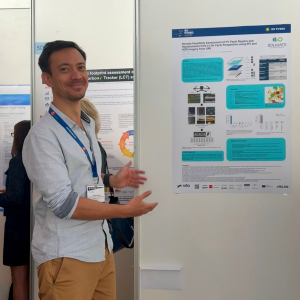
Christoph Waibel presenting the SolMate poster “Remote Feasibility Assessment of PV Panel Repairs and Replacements from a Life Cycle Perspective Using IRT and HDR Imagery from UAV”
The study proposes a remote inspection workflow using drone-captured RGB and infrared thermal (IRT) imagery. Researchers apply multiple classification models to identify defect types, followed by lifecycle assessment which allowed them to calculate the carbon payback time (CPBT) for each intervention scenario: repair, replace, retain.
The study found that partial repairs can improve environmental impact significantly. While full panel replacements require up to six years to reach carbon break-even, partial repairs, such as fixing backsheets or junction boxes, can reduce CPBT to as little as 0.03 years.
The VITO-Inflight study also mapped out PV components prone to failure and how they can be detected using RGB and IRT imaging. While RGB imaging detects glass breakage and delamination, IRT captures hotspots and thermal anomalies. By integrating both imaging techniques, a PV farm owner can obtain a comprehensive diagnostic of the plant. The SolMate paper calls for new PV panel designs that allow easier separation of layers, thus enabling and facilitating repairing.
The paper’s conclusions gain relevance especially in the context portrayed by IEA-PVPS Task 13 at EU PVSEC on the reliability and qualification of second-life PV modules.
[Sol]Mates: Growing PV circularity ecosystem: Industry engagement and Horizon Europe synergies
Beyond its scientific contribution, SolMate ‘scouted’ for synergetic Horizon Europe projects and identified other [sol]mates – QUASAR and EverPV, both addressing PV circular economies and end-of-life management.
Innovation was not missing from this event, EU PVSEC being a platform for start-ups like Solar Materials and 2nd Cycle, both proposing advanced recycling techniques, from EVA (ethylene-vinyl acetate) film separation to hot knife glass removal. Meanwhile, companies like Mondragon and Sciprios showcased their automated production and testing systems, hinting at the future of scalable, repair-integrated PV manufacturing.
Policy and market signals
A dedicated industry panel at EU PVSEC 2025 explored scenarios concerning European PV manufacturing in the context of its motivation to support energy independence and lower environmental impact. While European companies are scaling up multi-GW production, the market remains vulnerable to China’s oversupply of cheaper panels, creating challenges to a second-life PV market. Europe’s competitive edge lies in its lower grid carbon emissions, making locally produced panels more sustainable. Panelists called for regulatory support to increase demand for EU-made products and ensure market stability for investors.
Other EU PVSEC panel discussions outlined various concerns, some echoed by SolMate’s motivation:
- The fragility of newer PV technology
- The lack of repair-friendly designs
- The request for policy support, voiced by EU machine builders and manufacturers, to scale local production and integrate hybrid PV-storage systems into the grid
Useful links:
- Conference Highlights: https://www.eupvsec.org/images/2025/conference/EUPVSEC2025_ConferenceHighlights_Robert_P_KENNY-web.pdf
- Press Release: https://www.eupvsec.org/images/2025/news/pr_sep2025-2/EUPVSEC-PressRelease-26September2025.pdf
- Detailed Conference Program: https://www.eupvsec.org/images/2025/conference/EUPVSEC2025_ConferenceProgram_web_v6.pdf
- PV market data and analysis on circular economies: https://jpmsilicon.com/pv-waste-hub/
- Digital Product Passport for Solar Modules: https://jpmsilicon.com/pv-waste-hub/
- PV Sustainability, IEA-PVPS Task 12: PV Sustainability – IEA-PVPS